

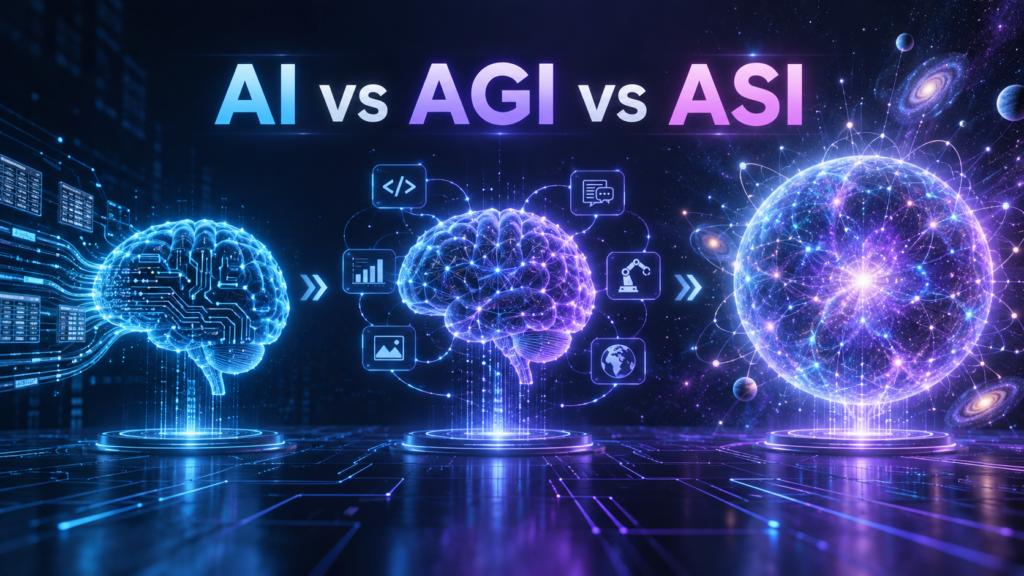
Artificial Intelligence is no longer a concept restricted to research labs and science-fiction novels, it has already started to change how companies analyse data, build products, connect with customers, automate processes and make decisions.
However, the intelligence already seen in computer systems is only the beginning.
The conversation around Artificial Intelligence is slowly shifting from AI to AGI, and then to ASI (Artificial Superintelligence).
The differences between AI, AGI, and ASI are crucial for students, professionals, and even businesses to understand, considering their impact on skills, jobs, and the global economy.
Artificial Intelligence: The Technology Already Changing Jobs
Artificial Intelligence refers to computer systems that can perform tasks normally associated with human intelligence. This definition generally includes systems capable of pattern recognition, language understanding, content creation, analysis, and recommendations, but all of these require specific programming.
Modern-day AI has already penetrated almost every industry, with applications including software development, data science, business processes, healthcare, finance, marketing, manufacturing, and education.
These are all areas where software can perform tasks associated with human intelligence — however, it still requires human guidance, data, specific instructions, and oversight to function.
Therefore, while AI can transform businesses, it is unlikely to replace humans immediately rather, it will take over some tasks.
Artificial General Intelligence: Beyond Special-Purpose Software
Artificial General Intelligence, or AGI, is a hypothetical level of intelligence that would allow computer systems to perform intellectual tasks associated with humans.
In other words, AGI systems would be able to perform all tasks associated with AI, but without the need for specific programming.
For example, an AGI system could switch from analysing data to writing software effortlessly unlike modern systems that are programmed to perform specific tasks.
AGI systems would include features such as
• learning and applying knowledge from one area to another
• understanding context
• reasoning
• planning and executing actions
• adapting to new information
AGI has not yet been achieved, and there are no established benchmarks for its creation, but it is already being theorized. The rise of multimodal AI systems, reasoning algorithms, and autonomous agents has already begun.
Artificial Superintelligence: Intelligence Beyond Humans
Artificial Superintelligence refers to intelligence beyond human capabilities. While AGI systems would be comparable to humans, ASI would be exponentially more capable and influential compared to modern systems or even humans.
Such systems would allow unprecedented advances in science, medicine, engineering, economics, and other fields, but the ethical concerns and existential risks posed by them are significant.
The development of ASI, if it is possible, would be a crucial milestone for humanity, but it may also be extremely dangerous. Therefore, debates around ASI are not only focused on its creation, but also on ethical concerns and control over such systems.
AI vs AGI vs ASI: The Core Difference
| Stage | Definition | Capability | Current Position |
| AI | Artificial Intelligence | Performs specific intelligent tasks | Already in widespread use |
| AGI | Artificial General Intelligence | Could learn and reason across different domains | A research goal |
| ASI | Artificial Superintelligence | Could surpass human intelligence | A theoretical possibility |
The evolution can be understood simply:
AI performs defined tasks. AGI could understand and adapt across tasks. ASI could potentially exceed human capabilities across most domains.
The Bigger Shift: From Using Tools to Working with Intelligent Systems
While the difference between AI, AGI, and ASI is substantial, the most important change enabled by AI is already happening. Modern software is quickly evolving from tools that simply follow specific instructions to systems capable of understanding, reasoning, and assisting humans in tasks that were previously impossible.
At any stage, AI can help humans by automating processes, reducing the amount of repetitive work, suggesting solutions, and even recommending actions based on available information and goals.
This means that in the future, a developer will not dedicate as much time to coding and more to building reliable systems, creating tools for other developers, and working on applications.
Similarly, data analysts will spend less time on data visualisation and more on building reliable statistical models and advising businesses. Marketers will combine their creative skills with AI-driven analysis and suggestions, while business analysts will rely more on AI to build processes and make recommendations. Managers and other professionals will utilise more automated tools and rely on their own expertise to make important decisions.
Therefore, the role of most professionals will be to utilise AI-assisted tools rather than follow specific instructions, as was common for traditional software. In effect, most people who want to thrive in the modern economy will have to develop skills and competencies that would allow them to work with AI in the future.
Jobs vs AI: Displacement or Enhancement?
It is important to note that while AI can automate many processes, most jobs consist of multiple tasks.
Therefore, while routine procedures can be automated, more complex activities that require domain knowledge, judgment, and responsibility will remain the work of professionals.
The most impactful jobs are those that make decisions. As a result, they are the ones most likely to see a shift toward working with AI rather than relying on automation.
In effect, professionals who embrace the changes and utilise AI to make better decisions will have advantages over those who rely on traditional methods. With that in mind, it may be useful to think not about whether AI will replace jobs, but whether it will empower professionals and organisations that utilise it.
Therefore, rather than being a threat to employment, AI represents a force that can enable professionals, organisations, and even individuals to achieve more. However, to benefit from its advantages, the workforce will need to acquire new competencies.
Future Skills In An AI-Driven World: What Should You Learn?
To work with AI, the future workforce will need to include diverse expertise, spanning technical, human, and domain-specific skills.
Therefore, the first step toward preparing for the future is to assess what skills will be necessary in one’s profession and how to gain them.
Crucially, it is important to learn how to work with AI, not just use one particular tool, since technology is a constantly evolving sphere. Specific technical skills to focus on may include
• AI literacy
• Data analysis
• Software proficiency
• Cloud computing
• Coding
• Data engineering
• Critical thinking
• Domain-specific expertise
• Communication
• Ethics
• Creativity
The list demonstrates how most fields will benefit from a combination of domain-specific knowledge and broader, more technical competencies. However, it is important to note that, while technical knowledge is crucial for working with AI, human skills will become even more valuable.
AI can make recommendations, but only people can communicate with clients, discuss matters, negotiate deals, and build relationships. Therefore, most domains will continue to value such human qualities.
Upskilling for the Future: Why It’s Never Too Early to Learn New Skills
As the examples above demonstrate, learning new skills, particularly technical ones, is critically important. However, such education can only be beneficial once a person understands why they need to acquire them.
Most often, people start learning new skills when their jobs change, or their employer asks them to gain specific competencies. However, in a constantly evolving world where technology already transforms industries, a proactive approach is much more rewarding.
To truly benefit from the opportunities presented by AI, it is necessary to invest time and effort into learning new skills, including
• Understanding emerging technologies
• Gaining practical experience
• Finding new opportunities
• Applying current skills with new technologies
• Combining existing competencies with new ones
Such an approach will allow the workforce to prepare for upcoming changes and ensure that their expertise, skills, and competencies will remain relevant and competitive.
People should not wait for AGI or ASI to emerge and transform society; they should prepare for change as the economy and technology evolve. Upskilling while the opportunities are still available is always better than trying to catch up with the competition later. To make the most of AI’s possibilities, it is important to stay ahead of the curve and be prepared for the future.
Prepare for The Future With KSR Datavizon
The evolution from AI to AGI and beyond is already transforming industries and jobs. However, it is unclear exactly how these changes will manifest in one’s career or what skills will be required in the future.
KSR Datavizon offers career and technology consulting services that can help freshers, professionals, and even businesses find their own opportunities in an AI-driven economy.
If you want to stay ahead of the curve and prepare for the future, contact KSR Datavizon to arrange a consultation.
Website: www.ksrdatavizon.com


Most Commented